Friday, May 21, 2010

No longer safe...

Public sector jobs are no longer considered “safe” as the Government and society now expect more from them, says the country’s top civil servant.

Chief Secretary to the Government Sidek Hassan says public officials are now forced to re-look at how they do business, including doing away with redundancies.
Merit has become very important in a globalised and competitive world.
“When I first joined 36 years ago, public service was not the best-paying job, but it was almost a ‘guaranteed’ job as long as you didn’t commit a big boo-boo until retirement,” he told reporters after delivering a talk at a leadership workshop organised by the Muslim Council of Britain in Kuala Lumpur today.
He says there is now higher expectation of the public sector and civil servants have no choice but to improve or be replaced.
“If you don’t perform, we will have to find better ways to make you perform. If we don’t do things as expected, other people will do those things.
“Where public sector jobs was once seen as ‘safe’, it is not the case anymore in Malaysia.

He also reminded high ranking officers in the civil service to make their contact details public so they are accessible by e-mail and phone.
“Complainants must receive a response within 48 hours. We engage all media – print and online alike.
“We need to clarify queries raised both through the media and complaints bureaus. In short, nothing is sacrosanct to probe and questioning.

Sidek says the public sector need to drive the private sector by setting higher standards of service delivery.
He warned against complacency although Malaysia now ranked 23 out of 185 countries in the World Bank’s Ease of Doing Business ranking, 24th in the World Economic Forum’s competitiveness ranking and 10th in the Swiss-based IMD competitive ranking.
“Although we are ahead of countries like China, Italy, New Zealand in our competitiveness, it is still not good enough,” says Sidek.

Thursday, May 20, 2010

Time to reflect .....

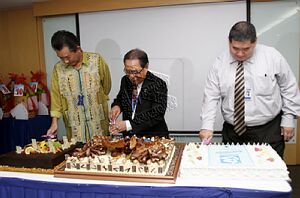
Clad in yellow t-shirts, 96 Bernama staff trod the various floors in Wisma Bernama looking for answers in a treasure hunt to celebrate Bernama's 42nd anniversary today.

Divided into 24 teams -- up from 18 last year, the participants had to tackle 35 mind-boggling questions.
The answers were ‘hidden’ in signages, frames and photos on the walls and along the corridors.
Even the automated teller machine (ATM) and a fund-raising box in the lobby made into the list of questions.
Making the occasion a joyous one, teams that produced ‘funny’ answers were also ‘rewarded’ with hampers.
While the search for answers occupied the minds of the participants during the hour-and-a-half long hunt, Bernama chairman Abdul Rahman Sulaiman said the anniversary was a timely occasion for Bernama to do some soul-searching.

Are we satisfied with what we are doing?
Can we fit into the present environment where the new media is a challenge for the traditional media in the dissemination of news?
How can we attract the IT-savvy young Malaysians who are turning to the internet for their news supply either from blogs or social networking platforms.
“To stay relevant, we must be prepared to change,” said Rahman in his ‘maiden speech’ to the staff since becoming chairman before presenting prizes to the winning teams.
But in doing so, he said Bernama must not forget the objective of its formation in 1967 – ten years after the country’s Independence.
Bernama’s services to subscribers especially in Sabah and Sarawak was vital to meet the spirit of national integration.
Spearheaded by the Father of Independence – Tunku Abdul Rahman Putra Al-Haj, the idea of setting-up Malaysia’s own news agency was crucial so as to relay government policies to the whole nation. It was to be what Antara was to Indonesia.
Having our own news agency was further justified to reduce dependency on the ‘Big Four” – United Press International, Associated Press, Reuters and Agence France Presse – which then controlled over 80 per cent of global news flow.
The debate for a New World Information and Communication Order (NWICO) was gaining momentum then over media representations of the developing world, who sought for more equitable and balanced news coverage.
Bernama was set-up on August 30, 1967 by an Act of Parliament and began operations on May 20,1968 from a now-demolished government bungalow, not far from Wisma Bernama.
From a pioneer team of seven at the start of its operation, Bernama now has some 600 staff.
In its first phase of operations, coverage was confined to Kuala Lumpur and its surrounding areas. Within a year of its operation, the agency established bureaus in Pulau Pinang, Ipoh, Kota Kinabalu and Kuching.
The third phase launched in 1970/1971, provided coverage for the whole nation with a network of state correspondents and stringers.
This was followed by the setting-up of overseas buraeus in Jakarta and Bangkok and the introduction of specialised services -- Economic Service and the Features and Foreign News Service.

Charting the progress of Bernama from a news agency to a multimedia organisation, Rahman said Bernama should strive to seek a balance between commercial need and maintaining professionalism.
“We have to make money and at the same time serve our subscribers.
“This would require creative and innovative ideas,”
says Rahman, whose appointment as Bernama chairman on Feb 1, could be described as the Malay saying of “sirih pulang ke gagang” (back to the grove).
After working as a radio reporter with RTM, he joined Bernama in 1971 and rose to become Editor-in-Chief before opting for retirement in 1995 to contest in the general election as the Barisan Nasional candidate for the Parit Buntar Parliamentary constituency.
Although he was not among the seven pioneer staff, Rahman has an emotional attachment with Bernama as he was involved in the structuring of the editorial operations.
His illustrious career in the agency spanned from being the bureau chief in Johor (1971–1972), correspondent in Thailand and Indochina (1976-1978), chief sub-editor (1978 - 1979), chief news editor (1979 – 1980), Editor Domestic News Service (1983-1984) and eventually to Editor-in-Chief (1989-1995).
On Prime Minister Najib Tun Razak’s call today for the media to be the Government’s partner in efforts to bring greater transformation to the country, Rahman said being a government agency, it was only logical for Bernama to carry out that responsibility.
This would mean explaining to the people the 1Malaysia concept, New Economic Model and Government Transformation Programme, among other things.
Speaking at the ground-breaking ceremony of Utusan Melayu (M) Berhad’s new headquarters at Jalan Chan Sow Lin, Najib said the media must give priority to news that was more knowledge-oriented so that the society could think in a more intellectual and objective manner.
“I know that journalism in the West would stress that conflict sells stories but don’t be obsessed with sensational stories because we want the nation to achieve physical success and intellectualism,” he said.

Congrats for excellent service …

In conjunction with Bernama’s 42nd anniversary, the agency presented Excellent Service Award to SSM and commercial staff.
It is an appreciation to them who have exceeded expectations in their duties and gone beyond the normal responsibilities of the job.
Evaluations are conducted annually.
Each recipient of the Excellent Service Award receives a certificate and a cash prize of RM1,000. The roll of honour for 2009:


Tuesday, May 18, 2010

Xiong Ping says goodbye ...

After slightly more than four years in Malaysia, Xinhua's chief correspondent Xiong Ping is leaving for home. As he bids farewell to contacts and friends, the senior journalist will take home with him lots of memories about Malaysia.
He is leaving at a time when China had just celebrated its Thomas Cup victory -- the most prestigious prize in badminton. They beat Indonesia in the final after stopping home team Malaysia in the semi-final.
Asked what he would miss most, he says simply: "The blue skies, white clouds and all-year round summer".
His successor Yan Liang had spent the last one-and-a-half years in Kabul as Xinhua's correspondent.
"The experience is unforgettable," says Yan.
Apart from our cooperation under the Organisation of Asia Pacific News Agencies (OANA), Bernama and Xinhua have had a close relation. While Xinhua has its bureau in Kuala Lumpur, Bernama has a correspondent in Beijing.


Xiong Ping (left) bids farewell as he introduces his successor Yan Liang when they dropped by at Bernama today.

Monday, May 17, 2010

Broadening regional contacts...

A group of eight information officers – four each from Indonesia and Brunei Darussalam, got to know more about Bernama during their visit today as we broadened our regional networking.

The visit was part of their four-day familiarisation programme organized by Malaysia’s Information Department.
Just a month ago, a group of senior officers from Brunei’s Information Department visited Bernama and requested to send their editorial staff and photographers for short photo-journalism courses.
An interesting question was raised during the briefing by one of the visitors who wanted to know why Bernama send a reporter to an event when other media representatives were present.
Being the national news agency, our subscribers are varied and widespread.
An important role of Bernama that is often overlook is being the ‘bridge’ in supplying news to our subscribers in Sabah and Sarawak and vice-versa -- in the true spirit of ‘1 Malaysia’.

Saturday, May 15, 2010

Of the KLIA mosque …

For many first-time visitors to Malaysia, the Sultan Abdul Samad Mosque is a lasting impression.

In fact, it is the first impression of Malaysia from the air other than the KL International Airport (KLIA) for a large number of them.
With its distinctive location on the eastern part of the KLIA, the mosque is a symbolic landmark that greets visitors to the country.
Come August 25, the blue-and-green dome mosque will mark the 10th anniversary of its opening.
Construction began in August 1997 and completed two years later.

Apart from local residents and airport employees, the mosque serves travellers plying the highway to and from the airport. It can accommodate up to 8,000 people.
The design of the mosque was envisaged to complement the overall nature theme of KLIA being "The building in the forest and the forest in the building".


Thursday, May 13, 2010

Eco-friendly JICA seeks feedback from Malaysians...

Japan International Cooperation Agency (JICA) started engaging with Malaysia in 1966 when it first provided technical cooperation. Since then, some 10,000 Malaysians have gone to Japan for training under JICA’s programme. The agency has also sent 3,000 experts to Malaysia who stayed in the country for more than a year.
The JICA Malaysia office was opened in 1975 and undertook the first training programme for the Look East Policy in 1982.
But despite its long involvement in the country, JICA’s Chief Representative in Malaysia Tsutomu Nagae says Malaysians still do not know the agency well.

"We’d like to know what Malaysians feel about our activities," he said during his visit to Wisma Bernama.
Nagae, who was a JICA volunteer himself in Kota Kinabalu 30 years ago, says the agency has provided 920 billion Yen (or RM30 billion) to implement 74 projects in Malaysia.
Being eco-friendly, JICA is prepared to join hands with local companies and government agencies to promote green technology in the country.
Nagae says JICA could provide appropriate financial and technical assistance in green technology which has the potential to become an important sector in Malaysia's economic development.
As part of its social reasponsibility, the agency is promoting social participation for persons with disabilities. It had organized a drawing exhibition by people with disabilities with the support from a leading shopping center-chain.
JICA collected more than 500 drawings from several handicapped homes and displayed the drawings to let the shopping centre customers pick their favourite.
Ten winning drawings were then selected and printed on reusable shopping bags which are now on sale at the shopping centre chain.
The funds generated from the sale will be contributed to the selected homes and centres for persons with physical disabilities that participated in the drawing exhibition.
JICA says the collaboration is a marriage between doing good for the handicapped people and doing good for the environmental protection.

The bag is made from a durable, light-weight and water-resistant material. It is suitable to replace the disposable platics bags. Using one of the bag, replaces the usage of 200 to 500 disposable plastic bags.

Monday, May 10, 2010

Bernama wins library excellence award ...

Bernama Informaton Centre and Library (InfoLib) made the agency proud when it emerges among three winners of the country’s Library Excellence Award 2009 presented today.
Bernama InfoLib came out top for the small library category, the Tun Abdul Razak Library of Universiti Teknologi Mara (UiTM) Shah Alam in the large library category, and the Malay Documentation Centre of Dewan Bahasa and Pustaka (DBP) in the category for medium-sized libraries.

The winners received their awards from the National Library of Malaysia (PNM) director-general Raslin Abu Bakar in conjunction with the annual general meeting of the Librarians Association of Malaysia.
Bernama was represented by general manager Hasnul Hassan.
Bernama InfoLib information manager Hasnita Ibrahim says the award will inspire the staff to be more creative in presenting and disseminating information.
This is in line with the effort of making Bernama InfoLib as a one-stopcentre for information.
She says participating in the competition for the first time was not too difficult as Bernama InfoLib already possessed the collection of information to meet the criteria.
Started in 2005, the award winners are picked based on their creative and innovative ways of presenting information to attract users.
Their good collection of information material and facilities are also considered.

Then and now ....

In 1974, we were like this ...


Yesterday, when a few of us turned up to honour 'Ibu', we were like this ...


A picture or two do tell a thousand words.....

Sunday, May 09, 2010

Bad's masterpiece ...

Badrul Hisham A.Aziz stayed up late to complete this 'sajak' for Ibu. The former Hulu Langat Member of Parliament could not hold back emotion when he chokingly delivered his masterpiece.
It was a beautiful composition, so well-written that I just have to reproduced it here.

IBU - Inilah Bingkisan Untukmu
 
I B U
Inilah Bingkisan Untukmu
IBU
Inilah Buah Usahamu
IBU
Ikhlasmu Bukan Untukmu
Ikhlasmu Bukan Ungkitan
Ikhlasmu Bekalan Untukku
Ikhlasmu Barakah Usiaku
IBU
Ibu Berkhidmat Untukku
Ibu Berjasa Usaha
Ibu Bersimpul Urat
Ibu Berkorban Usia
 
IBU
Ini Bukan Ungkitan
Ini Bukan Upahan
Ini Bukan Usikan
 
IBU
Inilah Banggaan Untukmu
Ingat Balasan Untukmu
Indahnya Belaian Unggul
Insaf Bersama Usia
 
IBU
Inilah Bangsa Usahamu
Ikrar Bantu Umat
Ikut Belaian Unjurmu
Ikut Bicara Urusan

IBU
 
I B U H A L I M A H
Hendak Aku Limpah Ingatan Menghimbau Awal Hidupku
Henti Air Linangan Imbas Mengenang Asrama Hingar
Harapan Agar Luput Igauan Mengusik Amannya Hidup
Halimah Ada Lipur Interaksi Menyelesai Apa-apa Halangan


IBU
Kaulah ibu dari usiaku 12 tahun
Ibu kandung pergi tanpa kembali sembilan tahun kemudian
Ibulah pengganti umi - hingga kini
Semasa sakit, Ibulah mengheret daku ke HBKL
Tatkala istirehat di Ampang Puteri, Ibulah yang muncul diri
Ibu inilah lah yang menyuap nasi….
Ibu inilah memicit kaki…sedangkan dia sendiri sukar berdiri
Tatkala di puncak jaya usahaku direstui
Doanya sering mengiringi
Mengingatkan daku jangan lupa diri
Bantu rakan-rakan yang kurang menjadi
 
Akhir bicara daripada anakmu ini
Kasih sayangmu kami hargai
Pesanan dan didikan jadi akujanji
Mustahil kan kami lupai
Biar putus bak tali
IBU TERSAYANG TETAP DI HATI KAMI…………….
PANJANG USIA JUMPA LAGI
 
 
Curahan hati LT. KOL (PA) BADRUL HISHAM ABD AZIZ, DPMS, ASa, PhD
Khas untuk Ibu Halimah Karnawi sempena Hari Ibu 9 Mei 2010

A tribute to 'Ibu'

She is and will always be our ‘Ibu’ (Mother). We will never forget how she stood up for us when we got into trouble. When one of us fell sick, she took him to hospital. She even kept him company, without fail, during visiting hours throughout his hospital stay.

She went out of her way to meet our request for the food we wanted. It was not cheap to have the food laid on the table. Once, she had the cook fry eggs from 9am to 3 in the afternoon just to serve us boys.
‘Sardin sambal tumis’ and ‘labu masak lemak’ were the favourite for most of us then as she recalled today when we gathered to honour her for ‘Mother’s Day’.
She had not seen many of us for years but she still remembered their names. She even remembers what or how they were like those days.
She was close to us for she had brought us up in her own special ways. She was our mother -- not to one or two but hundreds of us!
She is Halimah Karnawi – our ‘Ibu’ -- officially the hostel matron. Although the hostel – Asrama Dr Latif(ADL) is history – demolished and gone – to make way for a flood mitigation and a highway project, the memories remain in our hearts.
The ‘hi-tea’ event today is special in many ways. Though wheel-chair bound, ‘Ibu’ took the trouble to be with us.
“I just have to come to see you all,” she says with a tinge of happiness – tears welling in her eyes.
‘Ibu’ is 80 but as Nazam – the emcee for the day remarked -- her ‘memory card’ is tremendous!
The evening was also special because we had our ‘ustaz’ (religious teacher) – someone many of us have not seen for over three decades since we left school.
Ustaz Shaifuddin Yasin has this ability to recognize many of us just by the way we walked and some by their smell!

“It’s true, I can know them just by their smell,” he said and recalled the various nicknames that we had.
“Even now, I smile on my own when I recall the students of ADL and my wife would wonder why,” says Ustaz, now 66. He even sang an old favourite – “Kenanganku” , giving us a hint of his singing prowess.
The event was also special because it was the first time that we were able to get together after our buddy Aziz Shahrin took the effort to organize a grouping of former ADL hostelites. His ‘never say no’ attitude is showing progress.
For a start, our proposed name – Asrama Dr Latiff Alumni Network (ADLAN) – has been accepted by the Regisrar of Societies.
The hostel took in the first batch of students in 1971 – thanks to the vision of former Selangor Menteri Besar, the late Datuk Harun Idris.
Through his efforts, students from the various districts in Selangor who did well in their Stardard Five assessment examination held nation-wide were offered places to pursue their secondary education in Kuala Lumpur either at the Victoria Institution, St John’s Institution or Methodist Boys School.

As Protem committee chairman Professor Datuk Dr Mohd Jamil Maah paid tribute to Datuk Harun, he said it is now “pay back” time for us to serve the society.
“Although the hostel is gone, the spirit remains and let’s keep it alive,” says the University Malaya Deputy Vice-Chancellor, who was among the first batch of form four students in 1971.
Others who turned up today include Director-General of Valuation and Property Services Datuk Abdullah Thalith Md. Thani, Bursa Malaysia CEO Datuk Yusli Yusoff, Chemical Company of Malaysia Group Managing Director Datuk Dr Mohd Hashim Tajudin and Universiti Kebangsaan Malaysia Hospital (HUKM) Head of Department of Otorhinolaryngology, Prof Dr Abdullah Sani Mohamed. Former Hulu Langat Member of Parliament Datuk Badrul Hisham Abdul Aziz recited a self-penned, choking ‘sajak’ entitled ‘Ibu’.

Thursday, May 06, 2010

EU engages the Malaysian media …

To mark Europe Day, the “national” day of the European Union, the EU delegation office in Kuala Lumpur organized a luncheon between the 17 EU ambassadors in Malaysia and senior representatives of the Malaysian media.

Head of EU delegation Vincent Piket says the union wants to step up relations with Malaysia as part of their expanding relations with Southeast Asia.
"And because we recognize that, to realize that goal, it is vital to have close and open working relations with the media," he said.
With 27 member states presently and close to 500 million citizens, the EU says it deserves attention.
"Over the past 53 years, the EU has become the most advanced project for regional integration the world has seen so far. It is one of Malaysia’s most important trade partners.
And over the past decade, Malaysia and the EU have engaged politically at bilateral level, to promote stability and integration in Southeast Asia, and to address global issues,"
says Piket.

Dutch ambassador Paul Bekkers addressed the luncheon on Economy, Danish ambassador Svend Waever on Environment and Austrian ambassador Andrea Wicke on Values.
Spanish ambassador Jose Ramon Baranano gave the closing remarks as the EU Presidency-in-Office.

Footnote: During their summit in Milan in 1985, EU leaders decided to celebrate 9 May as Europe Day. Today, Europe Day is an annual celebration of the diversity of cultures within Europe and provides an opportunity to learn more about the European Union

Wednesday, May 05, 2010

Malaysian media directory...

A directory of the Malaysian media has been published -- thanks to the Information Department.
The 755-page directory not only list out "Who's Who" in the various print and electronic media organisations but also press secretaries of all ministers and public relations officers of government ministries and agencies.

The directory also contained contact information foreign media correspondents based in Kuala Lumpur. Even magazines, journals and prominent local news portal were not left out.
It is the first-time that such a thick directory has been published.
The department says: "The 2010 PUBLIC MEDIA DIRECTORY is published to assist users in locating media practitioners in various government departments, media agencies and other relevant organizations".
For more information:
Media and Corporate Communication Division
Department of Information Malaysia
12th Floor, East
Wisma Sime Darby,
Jalan Raja Laut
50350 Kuala Lumpur
Telephone: 03-21734400/4600
Fax: 03-21734554


The Malaysian Press Institute (MPI) too has painstakingly took the effort to published a directory of "Who's Who" in the Malaysian media. The directory is also available on its website http//mpi.com.my .
MPI chief executive Chamil Wariya hopes the 2011 edition would be more comprehensive.

Tuesday, May 04, 2010

Strong endorsement for proposed Bernama-Antara summit...

The proposed summit between the Malaysian National News Agency (Bernama) and Indonesian News Agency (Antara) will be held before the end of the year.

Malaysia’s Information, Communication and Culture Minister Dr Rais Yatim and Indonesia’s Communication and Informatics Minister Tifatul Sembiring gave the nod when the proposal was presented to them among a host of new initiatives to enhance bilateral cooperation.
"They will discuss the suitable programmes that both news agencies can work together on,” he told a media conference at the end of the 10th Malaysia-Indonesia Joint Committee Meeting on Information and Communication at the Craft Complex in Kuala Lumpur.
The two agencies also agreed to produced talk shows that would feature influential personalities and highlight current issues faced by both countries.
"For instance, we may invite my Indonesian counterpart to speak to Malaysians through our media channels. This will prevent sensitive issues from getting out of control," says Dr Rais.
Bernama and Antara will also exchange video clips and documentary films they produced.
They will also cooperate in launching Antara TV that could modelled Bernama TV round-the-clock all news channel. Antara TV currently operates as content provider for other TV stations in Indonesia.
Both parties concur that TV Antara could help realize the TV Nusantara vision that would further strengthen the Malay language as the lingua franca of the region.

Monday, May 03, 2010

A new milestone...

Malaysian and Indonesian senior officials got down to discuss efforts to strengthen cooperation in the information and communication sectors.
The Malaysian side was led by Information, Communication and Culture Ministry Secretary General Kamaruddin Siaraf while Indonesia's Ministry of Communication and Informatics Secretary General Dr Basuki Yusuf Iskandar led his delegation.

Both had gone to the same university -- Vanderbilt University in the United States although Kamaruddin was there much earlier.
That alone set a conducive start to the talks aimed at reviewing the Memorandum of Understanding on Information signed by both countries in 1984. The review was necessary with the expansion of the Malaysian ministry to include the communications and culture sectors.
While Kamaruddin said the talks would enable them to take into account the new perspective, Basuki regarded the meeting as a new milestone in enhancing the cooperation.
Activities that have been implemented include exchange of radio and television news, production of radio and television programmes, production of drama and films, and exchange programmes for information officers, media practitioners and technical personnel.
Decisions made by the senior officials will be forwarded to the ministerial-level meeting tomorrow. Malaysian Information, Communication and Culture Minister Dr Rais Yatim is scheduled to the Indonesian Communication and Informatics Minister Tifatul Sembiring tomorrow.

Sunday, May 02, 2010

Bernama-Antara agree to hold summit….

A top-level meeting between Bernama and Antara has been agreed upon to bolster their existing solid relationship.

The proposal was endorsed by both agencies in Kuala Lumpur today at a pre-council meeting ahead of the Malaysia-Indonesia Joint Committee on Information and Culture Meeting (JCICM).
The Bernama-Antara Summit will enable both sides to deliberate on issues of common interest and formulate initiatives that could boost Malaysia-Indonesia ties.
The idea had cropped up on the sideline of the recent Organisation of Asia-Pacific News Agencies (OANA) summit meeting in Seoul.
To put the inaugural summit in place, Antara, represented by its international and economic division head Bambang Purwanto, proposed that a preparatory meeting of “three or four editorial staff” from each side be held. Bernama General Manager Hasnul Hassan agreed on the ‘prep meeting” – the date and venue to be suggested by Antara.

Another new initiative agreed at the meeting was the exchanging of video clips -- in line with the decision taken at the OANA summit. Antara currently provides news content for various television stations in the republic.
With its experience in running an all-news, round-the-clock Bernama TV, the Malaysian national news agency was prepared to cooperate with Antara should it decides to set-up its own TV station.
Apart from exchanging video clips, both sides agreed to collaborate in the joint-production of TV talk show and even documentaries.
On existing cooperation, they agreed to expand the journalist attachment programme to include photographers. Both sides also agreed to step-up the marketing of their news – a potentially lucrative area.

Tuesday, April 27, 2010

Kamsahamnida...

Kamsahamnida -- that's 'Thank You' in Korean.
As we headed for home, my thoughts were drawn to the memorable stay in Seoul. It was like going back into time when I put up at the same Lotte Hotel which I had stayed for an assignment five years ago.

I had then covered former Prime Minister Abdullah Ahmad Badawi's trip to Seoul where he pledged Malaysia's continued commitment for the 'Look East' policy.
But the trip this time was different. It was for the Organisation of Asia Pacific News Agencies (OANA) summit meeting organised by South Korea's Yonhap News Agency to commemorate its 30th anniversary.
In a way, it was historic as the 41-strong OANA decided to venture into multimedia -- getting its members to exchange video clips.
This is something new from the existing arrangement of text-based news and photo exchange that has been going on for years.
Just as cherry blossom starts to bloom all over Seoul, the colourful sight of early spring mirrored the pledge of the OANA members to expand cooperation into the multimedia platform.

In fact, the meeting took place at this time to coincide with spring which offered a breathtaking view of the city with colourful flowers along the streets.

Friday, April 23, 2010

Banking on each other ....

Asian news agencies' once heavy reliance on major Western news wires to carry news about Asia appears to have changed, This was the finding revealed by a research on the new trend in Asian news flows.
Prof Choi Young Jae of South Korea's Hallym University, who conducted the research on nine Asian news agencies over a 10-day period last July, said most of the news about Asia, relayed by news agencies, now came from fellow Asian counterparts.
"Even North American and European news stories are mostly coming from Asian news agencies. In other words, Asian news agencies produce Asian, American and European news stories on their own," he told the Organisation of Asia Pacific News Agencies (OANA) Summit Congress in Seoul.

The research project was to determine the degree and how the news agencies which included Bernama, the Malaysian national news agency, report about Asia.
The other agencies were South Korea's Yonhap, host of the four-day summit here, Xinhua (China), Kyodo (Japan), Philippines News Agency (PNA), Press Trust of India (PTI), Thai News Agency (TNA), Antara of Indonesia and Vietnam News Agency (VNA).
Choi said another important finding of the study was that Asian news agencies tended to portray Asia not so negatively but fairly, in keeping with their neutral stands.
"Asian news agencies (now) have their own voices in covering Asia and the world, competing with their Western counterparts," said Choi, who is also a board member of South Korea's News Agency Promotion Foundation.
Having achieved success in the text news services, he said the summit could be a springboard for the 40-member OANA to cooperate in multi-media contents.
He noted that the agencies were moving into multi-media platform by having television news, internet services and smart phones television applications.

Thursday, April 22, 2010

Bracing for the "pendulum power swing" .....

After months of tedious preparations, the first-ever Organization of Asia Pacific News Agencies (OANA)Summit Congress raised its curtain at Seoul's majestic Lotte Hotel.
Host Yonhap News Agency had done a truly excellent job to stage the summit in conjunction with its 30th anniversary.
Many delegates were caught surprise when South Korean Prime Minister Chung Un-chan turned up to open the four-day meeting.
His message was clear -- Asia-Pacific news agencies need to raise their cooperation to new heights as the "pendulum of global power is swinging towards the region".

He said the region was not only the world's largest and most populous but the most rapidly changing as well.
"Asia-Pacific was among the earliest to recover from the recent financial crisis, fuelling recovery in the rest of the world," said Chung, who noted that South Korea now stood as an important player in global affairs.
The meeting sought to broaden multilateral cooperation among Oana members in the face of a rapidly changing global media environment.
Chung said Oana, formed in 1961 on the initiative of Unesco, could help narrow the information gap separating developed and developing nations.

"Oana members have indeed played a crucial role in the region's rapid and dynamic advancement. You deliver the latest news swiftly and accurately, painting a vivid picture of Asia-Pacific far beyond the region," he said.
Saying he was aware of the world's high expectations for South Korea to "make the world a better place for everyone", he urged Oana members to write and report about the country.
"World leaders from developed and developing nations will meet in (South) Korea this month for the 2010 G-20 Summit. (South) Korea will also be the host of the 2012 Nuclear Security Summit," he said.
Oana President Dr Ahmad Mukhlis Yusof said the theme for the summit, "Challenges and Opportunities for News Agencies", was relevant and urged members to tap the information technology.
"The imbalance and difference of information flow between the developing and developed countries have not been narrow by disputes for decades. Until now, there is a gap within the world information flow," said Mukhlis, who is chief executive of Antara News Agency of Indonesia.
Communications scholar Dr Oliver Boyd-Barrett, who delivered a keynote address, said he believed Oana has a role in helping to shape future change to the information flow.

"Two countries of the region (India and China) alone account for a third of the global population and economically the region is developing into the world's powerhouse for the 21st century.
"How can this not impact the global infrastructure of news flow?" said Dr Boyd-Barrett of Bowling Green University in Ohio.

Sunday, April 18, 2010

Rosy future for news agencies...

Asia-Pacific news agencies are set to hold an unprecedented meeting in Seoul this week as a United States-based journalism scholar predicted that news agencies hold vast potential for future growth.
This was despite all the misgivings voiced about news agencies in the early days of the Internet, said Prof Oliver Boyd-Barrett of Bowling Green State University in Ohio, who has been invited to speak at the Organisation of Asia-Pacific News Agencies (OANA) Summit Congress.
His study on the news agencies' prospect is published in his latest book "News Agencies in the Turbulent Era of the Internet", to be launched in Barcelona, Spain on May 10.
"I believe the book delivers a resounding message: despite all the difficulties, all the challenges and complexities of their business, news agencies as institutions of political, economic, cultural and social importance, survive and often thrive," he replied to my email questions ahead of the four-day OANA summit beginning Wednesday.

His observation will provide valuable insight for the meeting that will discuss "Challenges and Opportunities for News Agencies in the New Media Era" as its theme.
The meeting is expected to be the largest event in the history of OANA, which was formed in 1961 on the initiative of UNESCO to promote regional news exchanges, and now comprises 41 members from 33 countries.
Heads of news agency associations from Europe, Africa and the Middle East will also attend the Seoul summit as observers. It is co-hosted by South Korea's Yonhap News Agency as part of its 30th anniversary celebrations.
Boyd-Barrett said the single most important outcome of the OANA Summit would be the opportunity for member agencies to share experiences and potential solutions to the challenges that they collectively faced.
"Among the most important of the challenges they each face, inevitably, is the challenge of how best can agencies position themselves in the rapidly evolving age of both wired and wireless Internet."
Having conducted extensive research on global news agencies, Boyd-Barrett said OANA could do more than providing news exchange among its members.
"I would hope that there are greater possibilities for monetising this exchange with a view to developing regional news services of interest to media and non-media clients throughout the world, including the media markets of the most prosperous countries.
"This may entail a notable upscaling of investment including dedicated personnel, further development of regional enterprise and investigative reporting, and identification of new delivery systems.
"Additionally, OANA's role in the provision of professional training and development can only become more important in the years ahead," he said.
On OANA turning 50 next year, he said the "sheer durability" of OANA and of its member agencies was testimony to the continuing and essential importance despite all the difficulties that they faced, of the services that news agencies provided in the cause of public communication.
"For the future, I believe OANA can help provide a vision for multi-media, multi-modal news delivery and for the development of entrepreneurial services that may help provide revenues for future investments and enhance professional independence," he said.